Valentine’s Day giveaway – Roger&Gallet Rose Fragrant Water

Roger and Gallet is best known for its boxed soap sets.  It also makes fragrance waters.

Roger & Gallet says that its inspiration for its Rose Gentle Fragrance Water are “rose gardens deep within Bengal.”  Well, I have traveled widely through Bengal, and never encountered a rose garden.  In fact, the floral fragrance that I most associate with Bengal (and the rest of India, for that matter) is jasmine, which is strung into garlands to adorn altars.  Burning incense forms the undercurrent.
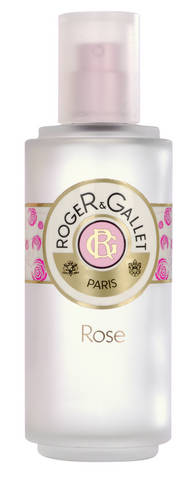
Prize: Roger & Gallet Rose  Gentle Fragrance Water (1 oz/30 ml)

That aside, Roger & Gallet Rose Gentle Fragrance Water has the following fragrance notes:

  • Top notes: rose, mandarin orange
  • Heart notes: peony, rosebud
  • Base notes: amber, almond milk 

While Roger & Gallet Rose Gentle Fragrance Water is a light true-to-a-rose fragrance, it lasts several hours after spritzing.

Now, just in time for Valentine’s Day, The Style Page is hosting a giveaway of a 1 oz/30 ml bottle of Roger & Gallet Rose Gentle Fragrance Water.  The contest will begin Monday, January 30, at 12:01 AM Eastern Time (-5 hr UTC/GMT).  U.S., Canada entries only.

/*{literal}{/literal}*/ a Rafflecopter giveaway<a href=”http://rafl.es/enable-js”>You need javascript enabled to see this giveaway</a>.

Hermes limited edition sari line

Hermès admires India and has a lot to learn from India.” So says Patrick Harris, chief executive of Hermès International.  Indeed.  The patterns and mix of colors (often colors that you think wouldn’t work together) found in Indian saris would be an inspiration to the French luxury leather goods maker known for its “beyond classic” silk scarves.

Hermes limited edition sari

Now Hermes has launched a limited edition collection of saris for the Indian luxury market.  At $6000-8000 a sari, I can see only Bollywood stars (and some uber-rich) being able to afford it. While I think that this picture is intended for fashion spreads only, no self-respecting Indian woman would go without a blouse!

Source: google.com via Julie on Pinterest

Jagjit Singh (February 8, 1941-October 10, 2011) #MusicMonday

Soon after I posted the video for last week’s #MusicMonday, I learned of the death of Indian ghazal singer Jagjit Singh that day (October 10).  He was admitted to ICU after suffering a brain hemorrhage.  Fans knew that it was only a matter of time.

In commemoration of Jagjit Singh’s life and career, I present this video for #MusicMonday:

This video is cross-posted on Mera Bharat Mahan.

Hair and the clash of cultures

March 2009 issue of Allure

The March 2009 issue of Allure features an article The Locks Market about the global trade in human hair to make wigs and hair extensions. It focuses on the Tirumala temple in India, where Hindu women have their hair shorn as a gesture of humility and thankfulness.

Tirumala

The article describes the process that the hair undergoes from being shorn to being made into extensions. The hair changes hands from temple auctions to Indian hair brokers who sell it to Indian factories that sort, clean, and fumigate hair, which in turn sell it to wig and extension makers in Italy or Tunisia. Then the finished products are sold to distributors all around the world.

We gave our hair to God, Tirupati, Andhra Pradesh, India credit: weblogtheworld.com

It’s a fascinating read, but it’s only part of the story. Orthodox Jewish women often cover their heads with a wig. A rabbinical ruling forbade the purchase and wearing of wigs from hair that came from Hindu temples such as Tirumala, which are regarded as polytheistic and idolatrous. These rulings also apply to getting rid of the wigs – one cannot sell them, as it only perpetuates the trade. When Orthodox Jewish women in New York discovered that the human hair in their wigs came from Hindu temples, they destroyed the wigs by burning them.

This article is cross-posted at Mera Bharat Mahan.

Cosmetics bags

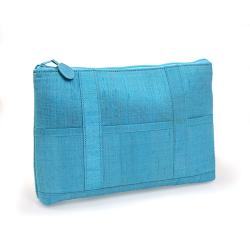
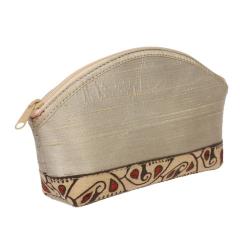
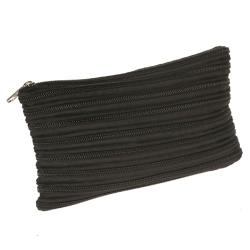
I collect cosmetics bags. I haven’t used them yet; the bags are lined up in my closet. Here are some selections from World of Good, which promotes fair trade handicrafts from around the world. You might have seen World of Good kiosks at Whole Foods Market or Wegman’s.

silk Come Full Circle Cosmetic Bag from Cambodia


silk Udder Joy Pouch from India

The trim on this pouch is characteristic of the Indian decorative art of kalamkari, where artisans sketch designs with burnt tamarind twigs and then paint the designs with natural dyes.

Hipper Zipper Pouch from Brazil

This pouch is actually made out of leftover zippers! While I wouldn’t put the silk pouches in my handbag for fear of getting them dirty, this bag is rugged enough for my handbag.

Cultural insensitivity?


Insenstive

I always enjoy visiting the i♥make-up blog for her posts on beauty secrets of Bollywood stars. On Monday, she posted an article on OPI’s India Collection nail polishes, in keeping with her India theme. As usual, OPI has come up with punny names for its nail polishes.

I scanned the above image from the March 2008 issue of Lucky (and if someone could tell me how I can prevent the reverse side from showing through, I’d be grateful). I found this picture of the model holding the turkey sandwich insensitive and lacking in cultural awareness, as a majority of Indians are vegetarians. Some Hindus eschew onions, garlic, and mushrooms as tamasic, that is, tending to sluggishness. Some abstain from certain foods on fast days. Observant Jains do not eat vegetables that grow underground, such as carrots and potatoes.

I do agree with i♥make-up, however, that this ad was probably not intentional. What do you think?

Block-printed textiles

The June-July 2006 issue of Domino had a feature on creating cushions and pillows with Indian block printed textiles. Its palette of white with pops of red used fabrics from Kerry Cassill and Les Indiennes.

The process of block printing, from creating the designs to transferring the design onto wood to carving the wood blocks to printing, is shown in a photo essay on the eSamskriti web site.

I have a duvet cover and reversible coverlet (the back side is a striped fabric) from John Robshaw in brown and blue on a natural background. It’s pricey, and my husband, who is a native of India, didn’t want to tell his mother how much he paid for it – she’d argue that he could get it much cheaper in India.


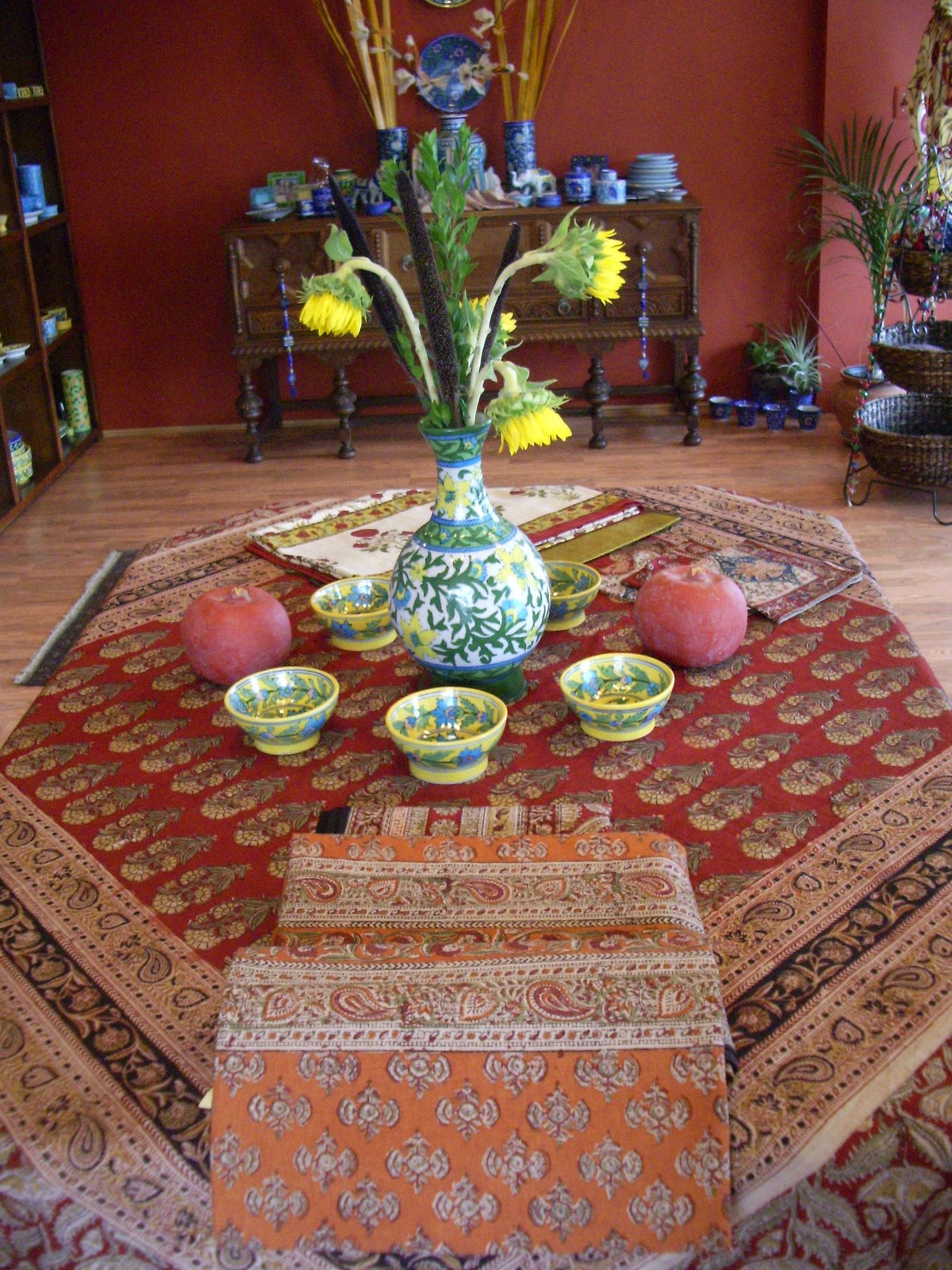
Block printed textiles from Pomegranates,
featured with Jaipur blue pottery
Visit the photo essay on Jaipur blue pottery making on esamskrati

Other sources for Indian block printed textiles include FabIndia (mentioned previously), Anokhi, and Pomegranates, a store located in Warrenton, Virginia, outside of Washington, DC. Wendy, who owns Pomegranates, sources her bedding and curtain panels directly from India; in addition, she sells select items from John Robshaw (including crib sets) and select apparel from Anokhi.

Peter Dunham is an LA-based interior designer who also sources blockprinted textiles from India. See his work for Jennifer Garner’s home in the fall/winter 2007 issue of Vogue Living.

Links for Kerry Cassill, John Robshaw, and FabIndia may be found on our Textiles page. Links for Les Indiennes, Anokhi, Pomegranates, and Peter Dunham may be found via My Web.

ColorBar: for our readers in India

After the U.S. and Canada, the next highest percentage of our readers come from India. A number of our Indian readers have inquired about ColorBar Cosmetics from the K.K. Modi Group. ColorBar is a relatively late entrant into the increasingly crowded cosmetics market in India and seeks to compete with Chambor, Lakme, and overseas brands such as Revlon and L’Oreal.

ColorBar has launched its own website at www.colorbarworld.com. ColorBar has also retained a creative company to study the brand’s performance in the Indian market (see agencyfaqs! > news & features > ColorBar Cosmetics moves to Law & Kenneth).

Currently, ColorBar is available only in select northern states in India. However, managing director Samir Modi has announced that ColorBar will expand into western India.

Clothes Shopping in India

Categories: , ,

I have twice (1, 2) made reference to our layover at Heathrow Airport. My husband and I were en route from India, where we visited his family.

While the sari is the dress most commonly associated with India, younger women are opting for the salwar kameez, which allows for greater mobility. A salwar kameez outfit consists of the kameez, a tunic; the salwar, a pair of loose pants (almost like a harem pant); and a dupatta, a long scarf or shawl. Sometimes, a tight-fitting pant called a churidar is substituted for the salwar.


Salwar kameez

More recently, young women in India have taken to wearing a kurta or short kameez over jeans or other western-style pants. As my niece noted, this outfit has become the working woman’s uniform.

Salwar kameez are typically sold as an entire outfit; however, department stores in India such as Pantaloons and Westside sell the individual pieces as separates. As I was frustrated in my search for simple cotton kurtas in the U.S., I picked up a couple of kurtas at Westside.

According to my niece, tailors can sew custom kurtas at a nominal price. At the upper end of the price scale is Fabindia, which does ship outside of India.

Women in #India get more #cosmetics choices: 2004

From 2004: agencyfaqs! > news & features > K.K. Modi Group forays into cosmetics (no longer available)

ColorBar Cosmetics (2004)

“THE Rs 2,500-crore K.K. Modi Group on Tuesday announced its foray into cosmetics with the launch of the ColorBar range of lipsticks, nail polish, kajal and compact.

While the formulations for most of these products will be imported, they will be manufactured through a third-party arrangement in Mumbai and marketed through a new group company, Serendipity Cosmetics.”

Find ColorBar online:


Web site: http://www.colorbarcosmetics.com
Facebook: https://www.facebook.com/colorbarcosmetics
Twitter: @lovecolorbar